
The complete Guide to skin Packaging
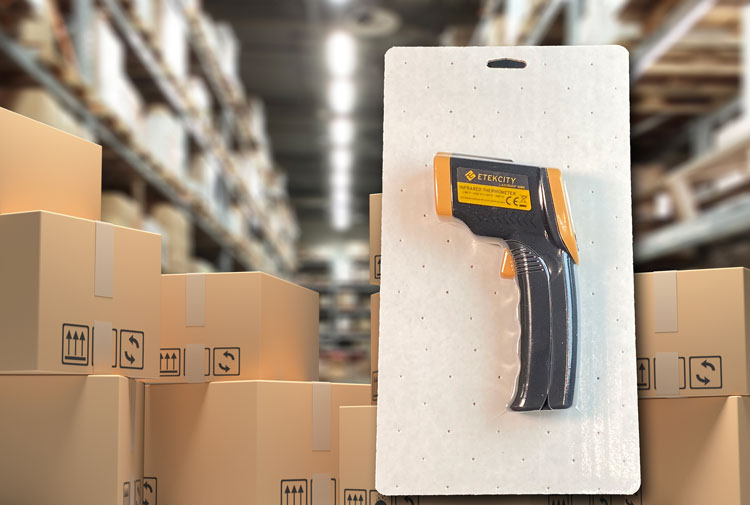
Vacuum skin packaging is a process in which a heated plastic film is formed tightly over a product and sealed to an adhesive-coated board using vacuum and heat. The film conforms to the product’s shape, creating a secure, highly visible package.
Unlike rigid blister or clamshell packaging, vacuum skin packaging relies on the bond between the film and the coated board to hold the product firmly in place. When properly processed, it provides strong containment, clear presentation, and efficient material use for both retail and industrial applications.
This guide explains how vacuum skin packaging works, how to select the right materials, and how to achieve consistent sealing results in real-world production.
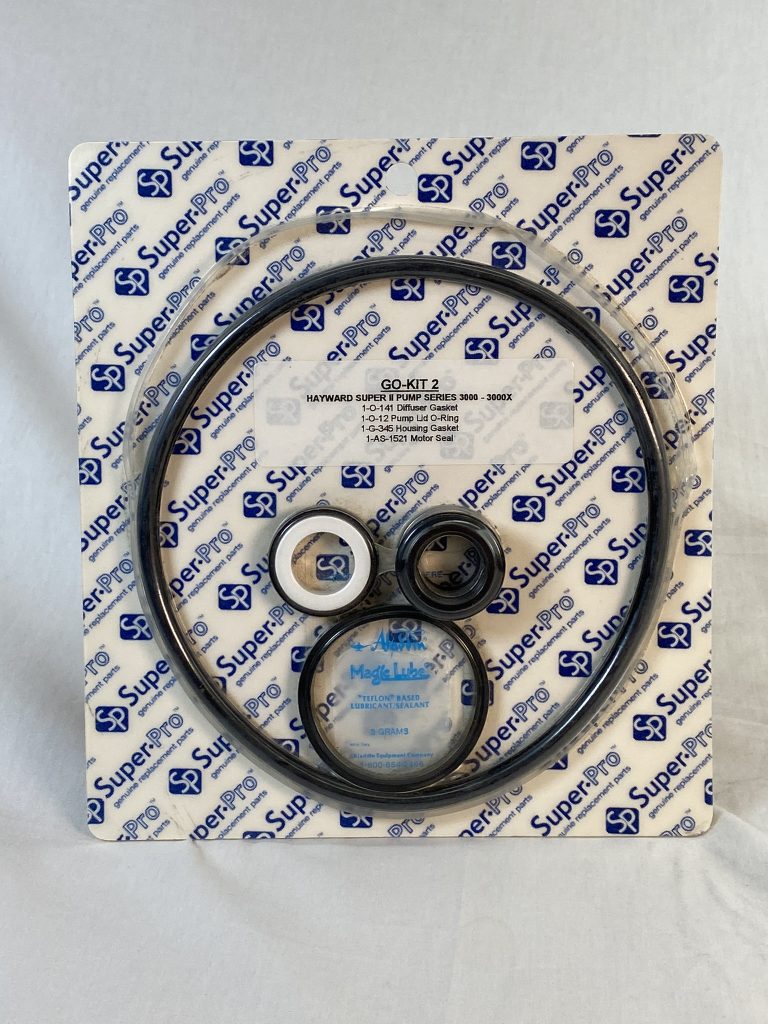
Table of Contents
What is Skin Packaging?
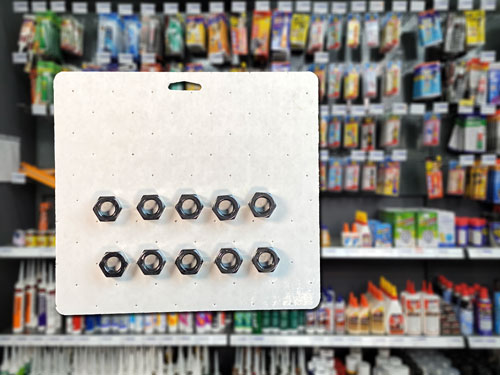
Skin packaging is a process in which a heated plastic
film is formed tightly over a product and bonded to a
coated paperboard substrate. The film conforms to
the shape of the product and is sealed to the board
using a heat-activated adhesive.
The finished package holds the product securely in
place while keeping it visible and protected. The
strength of the package comes from the bond
between the plastic film and the adhesive-coated
board, not from the film alone.
Core Components
A skin package consists of three primary elements:
The Adhesive
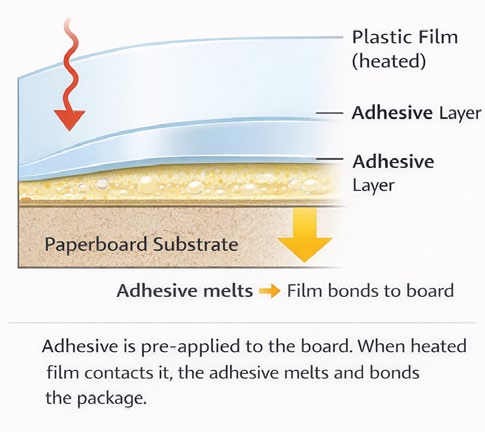
The adhesive is applied to the board during manufacturing with a flood coat that covers the entire sheet. At
room temperature it is solid and non-tacky. When heated to the proper temperature range, it softens and becomes capable of bonding to the plastic film.
The Substrate (Board)
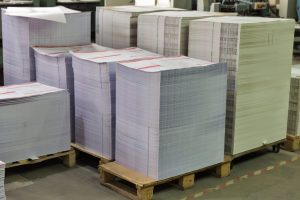
The substrate is typically a paperboard coated with a
heat-activated adhesive. It provides rigidity and the surface to which the plastic film bonds. It is available in different sizes and thicknesses as well as paper vs. corrugated cardboard
The Plastic Film
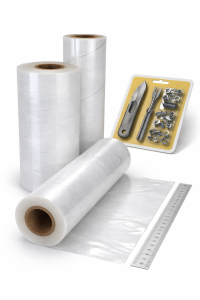
The plastic film, also called Surlyn Skin Packaging Film, is heated until it becomes soft and formable. Under vacuum, the film stretches over the product and is drawn down onto the adhesive-coated board. The film is available with and without adhesive.
Materials Selection: Board
Successful skin packaging begins with selecting the right combination of board and film. Board construction determines the rigidity and support of the finished package, while film thickness affects clarity, durability, and how the plastic forms over the product. Matching these materials to the product’s size, profile, and protection requirements is one of the most important steps in achieving consistent results.
Choosing Skin Packaging Board Type
Standard solid skinboard is typically a virgin paperboard .024 inches thick
This is the most common substrate for retail skin packaging and provides an excellent balance of
stiffness, appearance, and sealing performance.
Recycled solid skinboard is made from pulp-based material and is often produced at
heavier calipers, typically around 0.031 inches thick. Although thicker than virgin board, it tends to be
slightly less stiff and may require additional attention to airflow and sealing consistency.
Corrugated skin packaging board (corrugated cardboard only) is used when rigidity
and load strength are the primary concern. Corrugated substrates are common in heavy-duty
or industrial applications, but because they restrict airflow, they typically require perforation or
venting to evacuate air properly during sealing.
Laminated solid board is used when additional stiffness is needed beyond a single ply.
A common option is laminating two plies of 0.024 to create a combined thickness of approximately
0.048 inches.
Combination laminated structures can also be used, such as 0.024 solid board
laminated to corrugated, providing a clean printed appearance on the face with added
corrugated strength underneath.
Skin packaging board is typically supplied in standard sheet sizes that match common
machine frame dimensions. Frequently used sizes include(in inches) 12X18, 18X24, 24X30, 24X36, 30X36
Larger formats and custom sheet sizes are also available for specialized or high-volume
applications.
Materials Selection: Plastic Film
Skin packaging film is available in multiple thicknesses, or gauges. Most commonly in .005, .0075 and .010 with heavier gauges available by special order. Film thickness affects both the forming behavior during heating and the durability of the finished package. A common misconception is that heavier products automatically require thicker film. In practice, the more important variable is frequently the product’s height and the amount of stretch required to form smoothly over the product shape.
While product weight is sometimes a consideration, film thickness selection is often more dependent on product height—because taller products require the film to stretch farther during drawdown.
When to Consider Adhesive-Backed Film
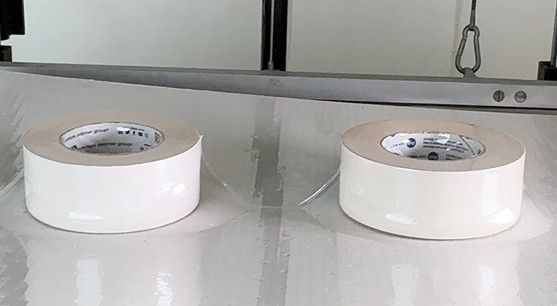
Adhesive-backed skin film can be advantageous when packaging on corrugated substrates. Because corrugated board is bulky and costly to ship with a factory-applied adhesive coating, some operations choose to source plain corrugated locally and rely on film with an integrated adhesive layer instead.
While adhesive-backed film may not produce the same fiber-tear bond strength typically achieved with coated solid board, it is often sufficient for corrugated applications. The rougher surface of corrugated material can support adequate bonding for many industrial or heavy-duty uses. In these situations, material availability and freight considerations may outweigh the need for maximum seal strength.
CPI Tip –
A lot of money can be saved by using multiple thicknesses of film. Having the appropriate thickness for different products can save significantly because you will only use what is needed for the appropriate stretch. Film that is .010 cost twice as much per cycle as film that is .005
How Wide?
The correct way to get the correct width is to first, determine which way the film enters the machine. Then measure the outside dimensions of the film frame perpendicular to that side. For example a 18 X 24 machine that loads from the left, you would measure the film frame from front to back, or 20″. You would need a 20″ width.
How the bond is formed
During the packaging cycle, the film is heated and formed over the product. As air is evacuated
from beneath the film, the plastic is pulled tightly against the product and into contact with
the adhesive coated board.
When these conditions are met, the adhesive bonds to the plastic film as it cools, creating a
strong bond. A properly formed seal typically fails in the paper fibers during a peel test rather
than separating cleanly from the board.
For a proper seal to occur:
the film must reach the correct forming temperature,
the adhesive must be heated enough to melt and activate,
and air must be removed efficiently so the film contacts the board while still hot.
Process Control and Printing
Why Process Control Matters
Skin packaging relies on the interaction of heat, airflow, materials, and timing. Small changes in
setup can have a noticeable effect on the final package.
Understanding the process as a system makes it easier to establish correct settings and
diagnose issues when they occur.
Printed Board and Color Considerations
Performance in skin packaging begins with the printed board. Decisions made during printing
and layout directly affect appearance, seal quality, and consistency.
Pantone (PMS) vs. CMYK(Process) Printing
Pantone (PMS) spot colors are typically preferred over CMYK process printing for skin packaging board.
Spot colors provide better color accuracy and consistency while requiring fewer printing plates, helping
reduce variation between production runs.
CMYK printing can be used in some applications, but it introduces additional variables that can be harder
to control, particularly when combined with adhesive coatings and heat exposure during packaging.
Does Skin Board Print Well?
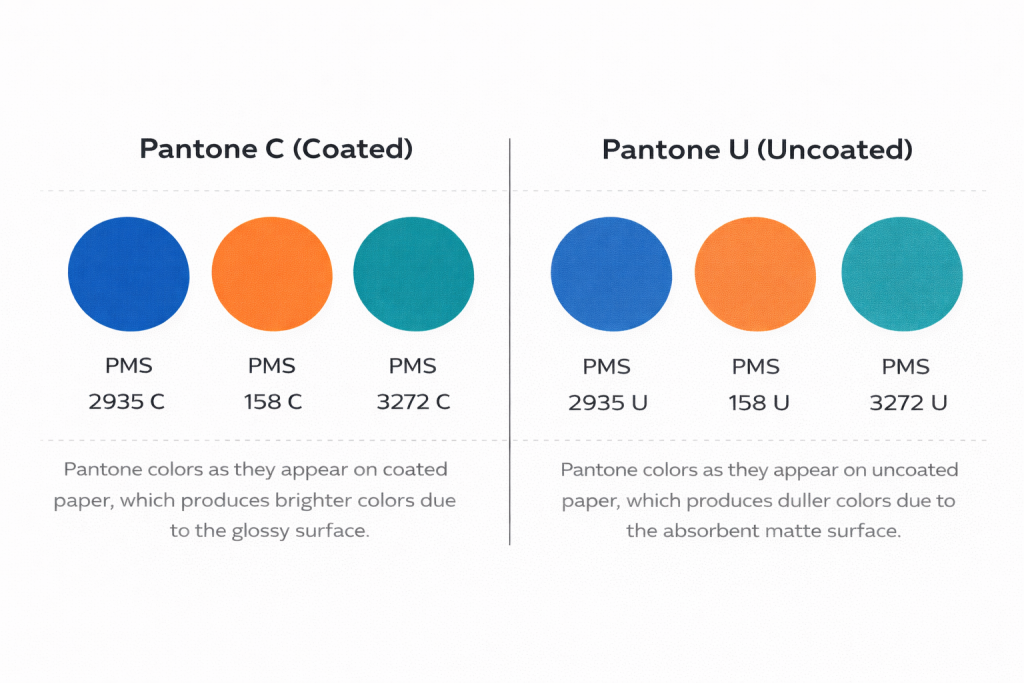
Skin packaging board is typically an uncoated paper substrate. Unlike coated papers, which have a smooth, sealed surface that reflects light and produces brighter, more vibrant colors, uncoated paper has a more porous, absorbent surface.
Because of this, printed colors on skin packaging board will appear different than the same ink printed on coated stock. Colors may look slightly softer or less saturated due to ink absorption into the paper fibers. This is normal and should be considered during artwork preparation and color selection.
When color accuracy is critical, it is important to reference Pantone U (Uncoated) swatches rather than Pantone C (Coated), since skin packaging materials behave more like uncoated paper in print performance.
Ink Adhesion
Ink adhesion is critical in skin packaging. Inks must be compatible with the board surface
and the adhesive coating. Poor ink adhesion can affect appearance and, in some cases,
interfere with proper sealing. For this reason wax-free inks are a must.
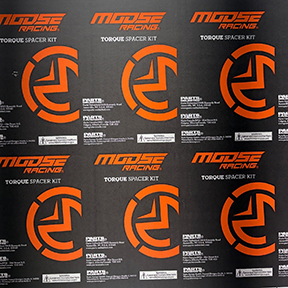
Artwork Layout, Gutters, and Scatter Prints
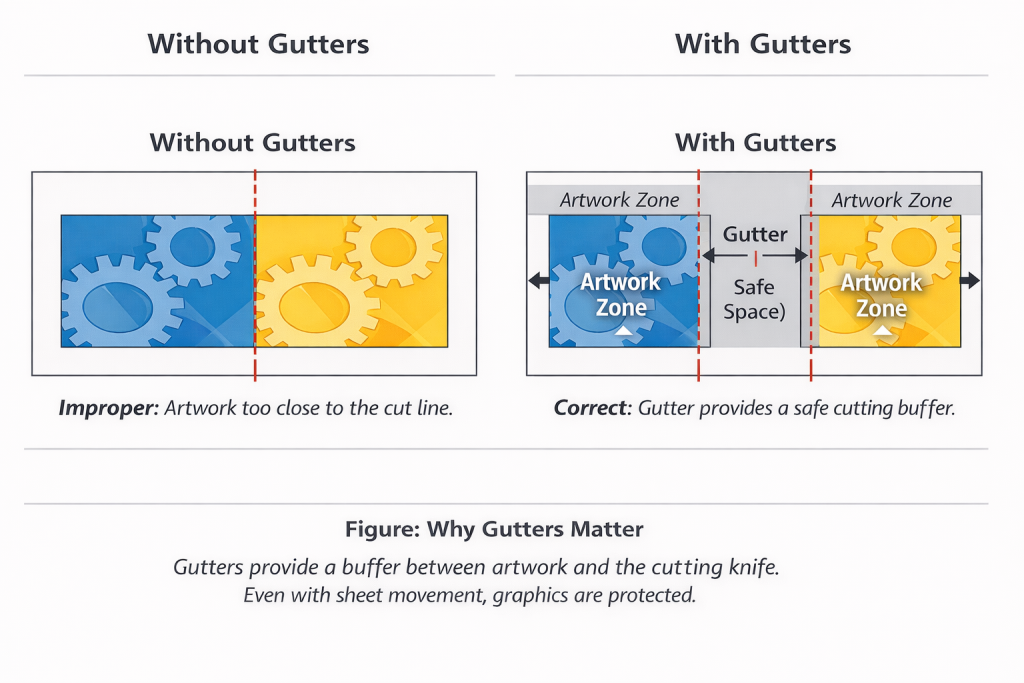
When multiple cards are printed on a single sheet, space must be left between each card to
allow for cutting. This space is referred to as the gutter. The gutter is an intentional buffer that allows cutting to occur without risking damage to the artwork. Even with accurate cutting methods, small variations exist due to board movement,
material tolerances, and machine setup. If artwork is placed too close to the cut line, even minor variation can result in clipped
graphics or uneven borders.
Scatter (Repeating) Print vs Dedicated Layout
Scatter Prints (Repeating Logo Patterns)
When card sizes are not fixed, a scatter print or repeating logo
pattern is often used. Scatter prints allow a single sheet to be
cut into multiple different card sizes while maintaining a
consistent appearance.
Because the artwork is not tied to a specific cut location,
cards of varying dimensions can be cut from the same sheet
without concern for alignment or border consistency. Scatter
prints combined with proper gutter spacing provide
maximum flexibility and reduce cosmetic cutting issues.

Dedicated Card Printing
Dedicated card prints are layouts in which each card is designed as an individual unit tied to a specific product or card size. Unlike repeating logo or scatter patterns, the artwork is fixed to a defined cut location, with borders, graphics, and product information positioned precisely for that format. This approach provides a highly controlled and consistent appearance but requires accurate cutting and careful alignment, since the artwork is dependent on the exact dimensions of each card.
Machine Setup and Operation
Tables and Material Flow
Proper table placement is an important but often overlooked part of skin packaging machine setup. For left-to-right machines, an in-feed table on the left allows operators to pre-load product and slide the board directly into the machine. An out-feed table on the right supports finished packages as they exit the machine, allowing them to remain flat. For back-loading machines, a table
positioned directly in front of the operator supports finished packages as they are removed from the machine. Tables improve workflow, reduce handling fatigue, and help maintain flatness during production.
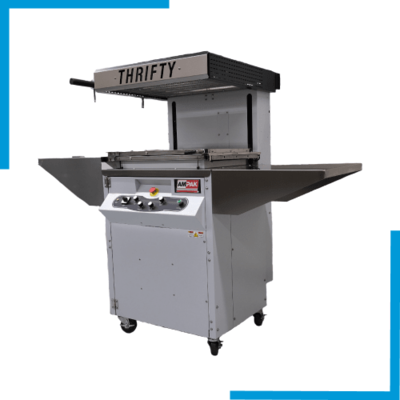
How to Pick the Right Skin Packaging Machine
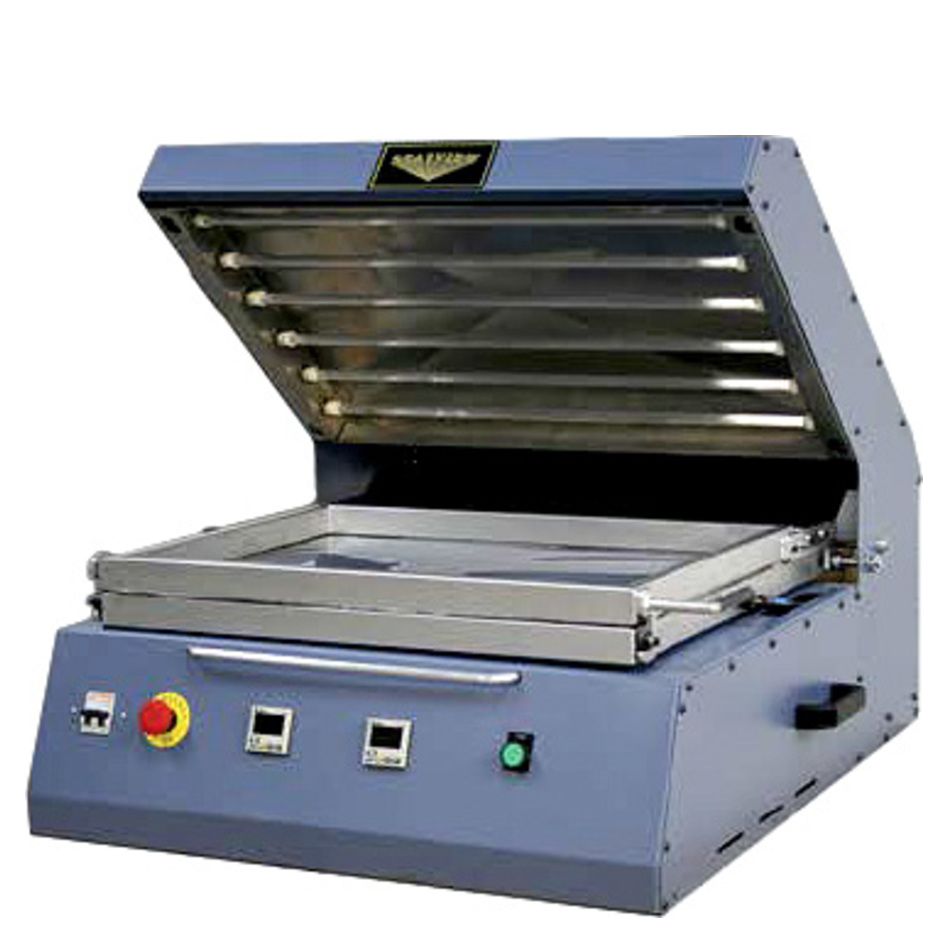
Most skin packaging machines operate on the same fundamental principles and complete a packaging cycle within a similar time frame. The core process—heating the film, drawing it down under vacuum, and bonding it to the board—is consistent across manufacturers. As a result, machine selection is less about speed and more about workflow, size, and operator involvement.
The primary difference between machines is size. Larger machines allow more product to be packaged per cycle, which can increase throughput. However, larger sheets also require more time to load and unload. In many operations, the gain in sheet size is partially offset by the additional handling time. Machine size should therefore be matched to typical product layout and production volume rather than selected solely for maximum capacity.
Another consideration is the level of automation. Manual machines require the operator to remain engaged throughout the cycle, while semi-automatic systems allow the operator to perform other tasks during heating and vacuum drawdown. The choice depends on staffing, workflow efficiency, and how production is integrated into the overall operation.
In terms of build quality, most North American–built machines are manufactured to similar standards and are designed for long service life. With proper maintenance, it is common for skin packaging machines to operate reliably for twenty to thirty years. Standard frame sizes and established designs have remained consistent over time, making longevity and serviceability important factors in the selection process.
Choosing the right machine is ultimately a matter of matching machine size and workflow style to production needs rather than seeking differences in fundamental packaging performance.
Setting Heat Time Using Film Sag
Film sag is a reliable visual benchmark for setting heat time. During heating, the film initially
shrinks, then softens and sags as it reaches forming temperature.
A practical way to establish heat time is to use film sag as the visual target and time the
heating cycle. When sag reaches approximately three to four inches in the center of the frame,
the elapsed time can be recorded and used as the baseline heat setting.
Some sag is required to ensure corners are fully heated. Excess sag only becomes a problem
when wrinkles appear. Operators should rely on film stretching during drawdown rather than
pre-stretching the film through excessive sag.
When machines are run in rapid succession, retained heat in the oven can effectively increase
heating time. If wrinkles appear partway through a production run, slightly reducing the timed
heat setting often resolves the issue.
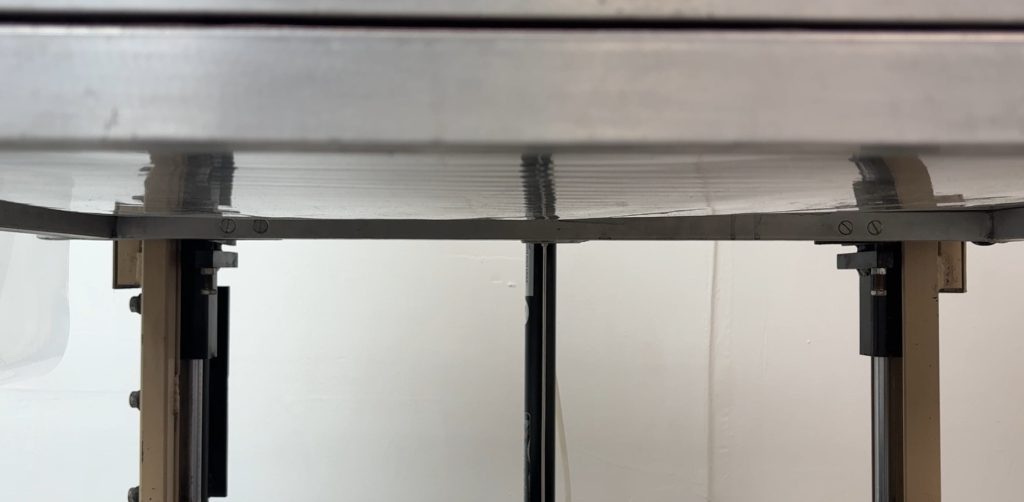
Film sag too shallow; may lead to poor corner heating.
CPI Tip
If multiple cycles are run in close proximity, heat can build up in the oven and affect film heating. Pay close attention and if wrinkles start to appear in the finished product, reduce the heat timer.
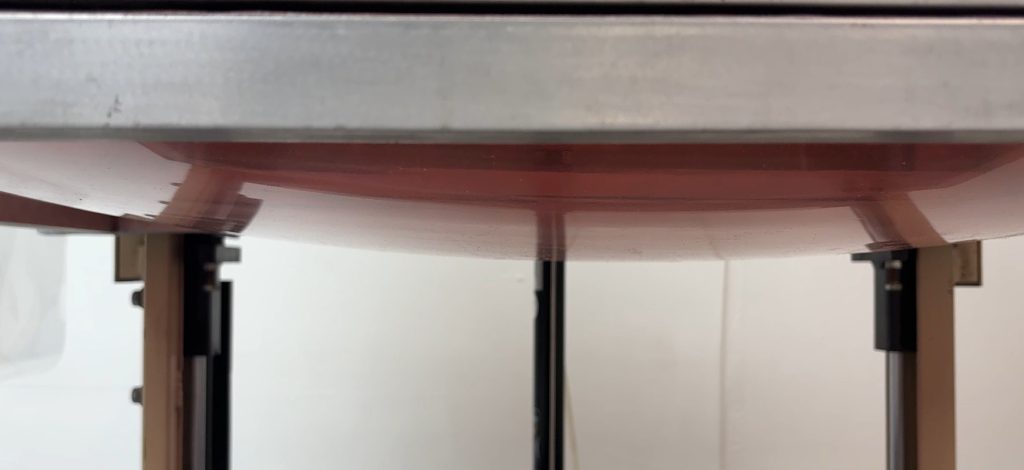
Proper sag benchmark: approximately 3–4 inches.
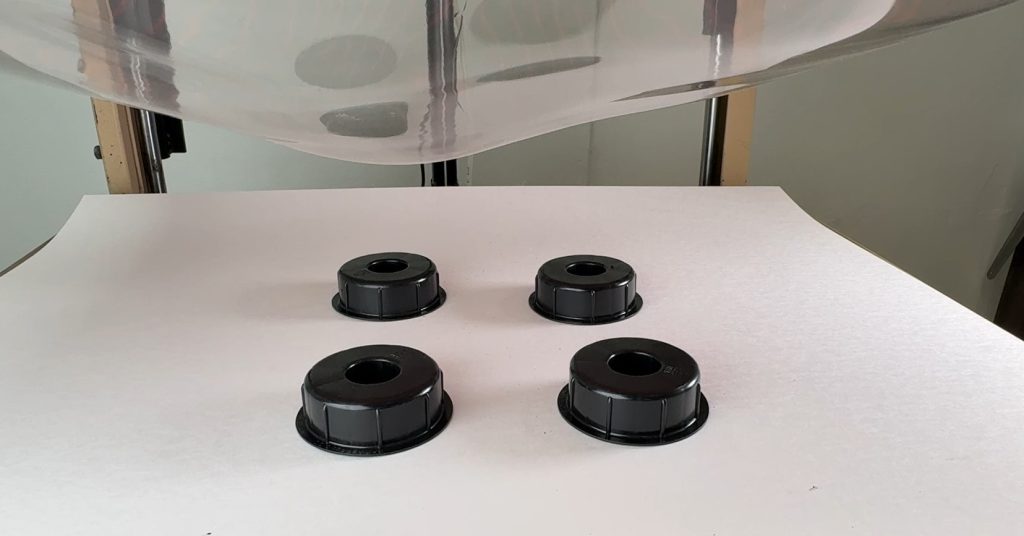
Too much sag increases surface area and may cause wrinkles.
Seal Quality and Testing
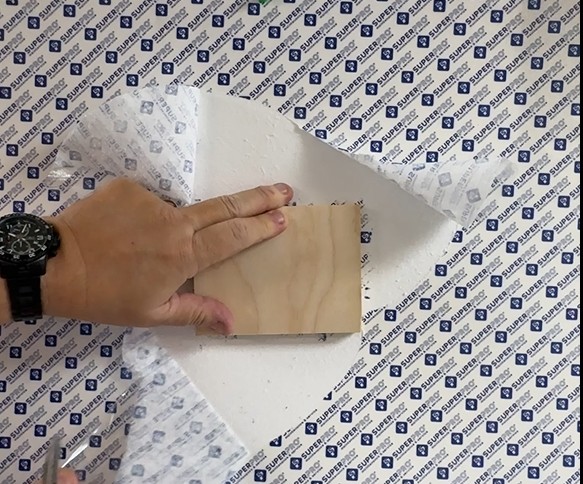
Visual appearance alone is not a reliable indicator of seal quality. Seals should always be evaluated using a physical peel test.
A good seal typically fails in the board fibers rather than at the adhesive interface. If the film releases cleanly from the board, the
adhesive has not fully bonded. Poor seals can result from insufficient film temperature, adhesive that has not fully melted, or slow air evacuation that allows the film to cool before contacting the board. The adhesive must reach its proper temperature window, typically around 170°F, to bond correctly.
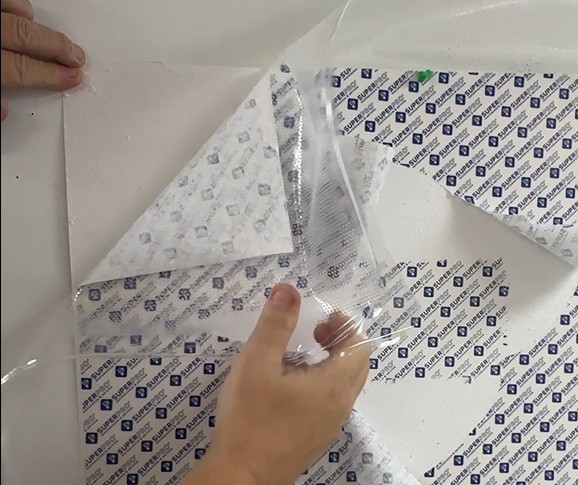
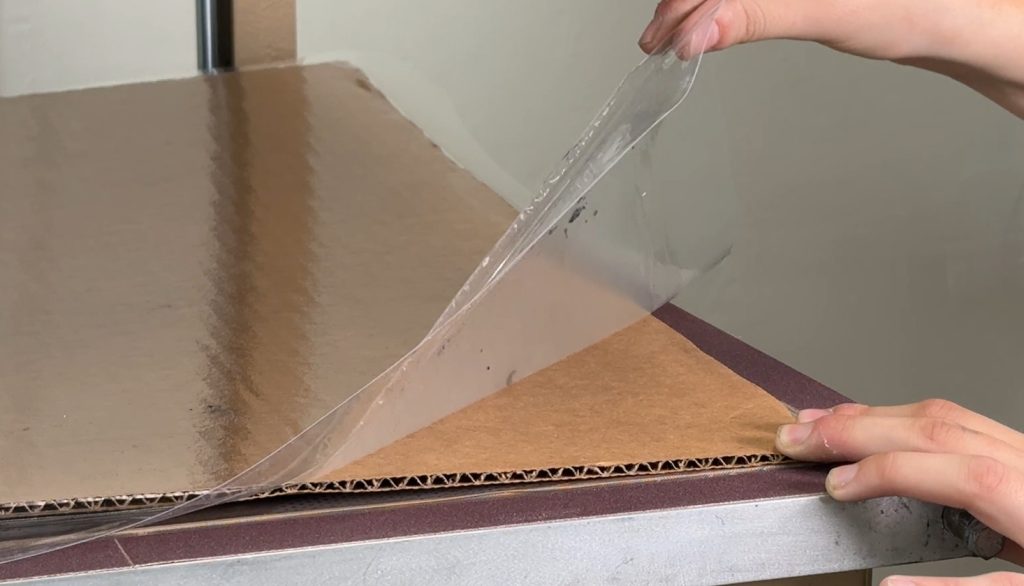
Demonstration of seal
testing at the corner.
Seal failure example;
must be confirmed by peel test.
Peel test showing fiber tear,
indicating a strong seal.
Airflow Through the Board
Proper airflow is essential for drawing heated film down to the skin board. Boards must be perforated or otherwise vented to allow air to evacuate, especially from the center of the sheet. Restricted airflow can prevent proper sealing even when heat settings
appear correct. In some cases, small slits behind products can help improve airflow when perforation is limited.
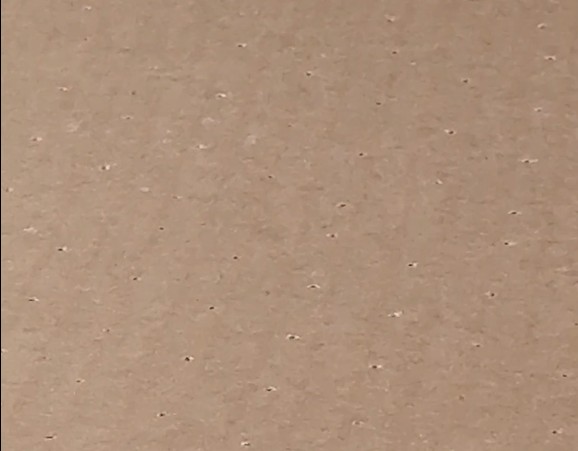
Perforations allow airflow through
board for proper evacuation.
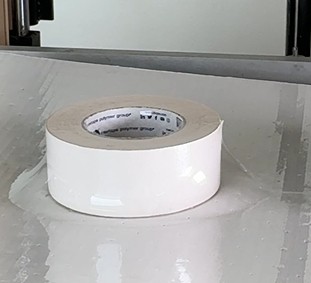
Restricted airflow can prevent
proper drawdown and sealing.
Finishing and Cutting Methods
Roller Die Cutters and Steel Rule Dies
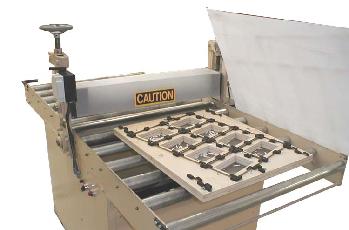
Roller die cutters are commonly used to cut skin packaging cards quickly and consistently.
The system consists of two counter-rotating rollers positioned between in-feed and out-feed
tables
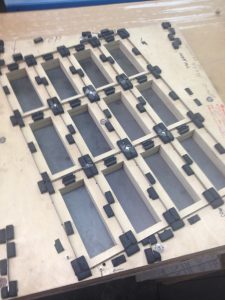
A flat steel rule die is placed on the in-feed table. The
printed board is positioned using registration pins, and
a cutting sheet is placed on top. As the assembly
passes through the rollers, even pressure is applied
across the sheet, producing clean, repeatable cuts.
Because the sheet is cut upside down, cavities are
created within the die to provide clearance so
packaged products are not crushed. For taller products,
additional plies can be added to increase cavity depth.
Starting Without a Die Cutter
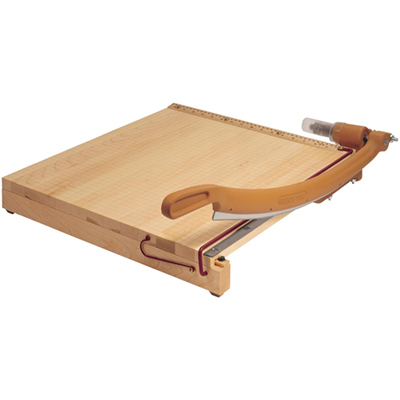
Because die cutters represent a significant investment, many
customers begin with manual finishing methods. These often
include a tabletop paper trimmer, a desk-mounted corner
rounder, and a hole punch.
Using these tools, it is possible to achieve clean, consistent cards
at lower production volumes. As volumes increase, many
customers transition to roller die cutting to improve speed and
efficiency.
Final Note
Skin packaging is a process that rewards
understanding. When issues arise, the most
effective solutions come from identifying root
causes rather than making adjustments without
understanding their impact.
This guide is intended to serve as a practical
reference for achieving consistent, repeatable
results and for troubleshooting common issues
with confidence.
Skin packaging and blister packaging are both carded packaging formats, but they function very differently.
Skin packaging uses a heated plastic film that is vacuum-sealed tightly over the product and bonded directly to a paperboard backing. The film conforms closely to the shape of the item, holding it securely in place without the need for a pre-formed cavity.
Blister packaging, on the other hand, uses a pre-formed plastic “blister” shell that is heat-sealed or glued to a backing card. The product sits inside the molded cavity rather than being wrapped tightly by film.
In general, skin packaging is often chosen for its strength, cost efficiency, and ability to secure irregular or heavy items, while blister packaging is commonly used when a more rigid, defined cavity is preferred for retail presentation
The skin packaging process is a vacuum sealing method that secures a product to a paperboard backing using heated plastic film. During the process, the film is softened with heat and drawn tightly over the product by vacuum pressure, forming a clear, protective “skin” that conforms to its shape. The film bonds directly to the coated board, creating a durable, tamper-resistant retail package.
No, not all skin packaging board needs to be perforated. Virgin skin board — typically around 0.024" thickness — does not require perforations because it allows air to evacuate properly during the vacuum process.
However, corrugated board and recycled materials generally do require perforations to allow air to pass through the substrate, ensuring the film draws down tightly and forms a proper seal around the product.
Skin packaging is used to secure products of varying shapes, sizes, and weights to a printed backing card using vacuum formed surlyn film. Because the film conforms tightly around each item, it can hold irregular, sharp edged, or mixed components in place without a molded cavity. This flexibility makes skin packaging especially ideal for product kits, multi-piece sets, and hardware assortments where items differ in size but need to be displayed and secured together in one package.
Yes, Pantone colors can absolutely be used in skin packaging. Spot Pantone inks are commonly used when specific brand colors need to be matched accurately on the printed backing card. As with any print process, the final appearance may vary slightly depending on whether the board is coated or uncoated, but Pantone spot colors are fully compatible with skin packaging card printing. In fact, they are preferred.
This document is provided for educational and informational purposes.
No part of this guide may be reproduced or distributed for commercial
use without written permission from CPI.
© 2026 CPI (Clearwater Packaging). All rights reserved.
